
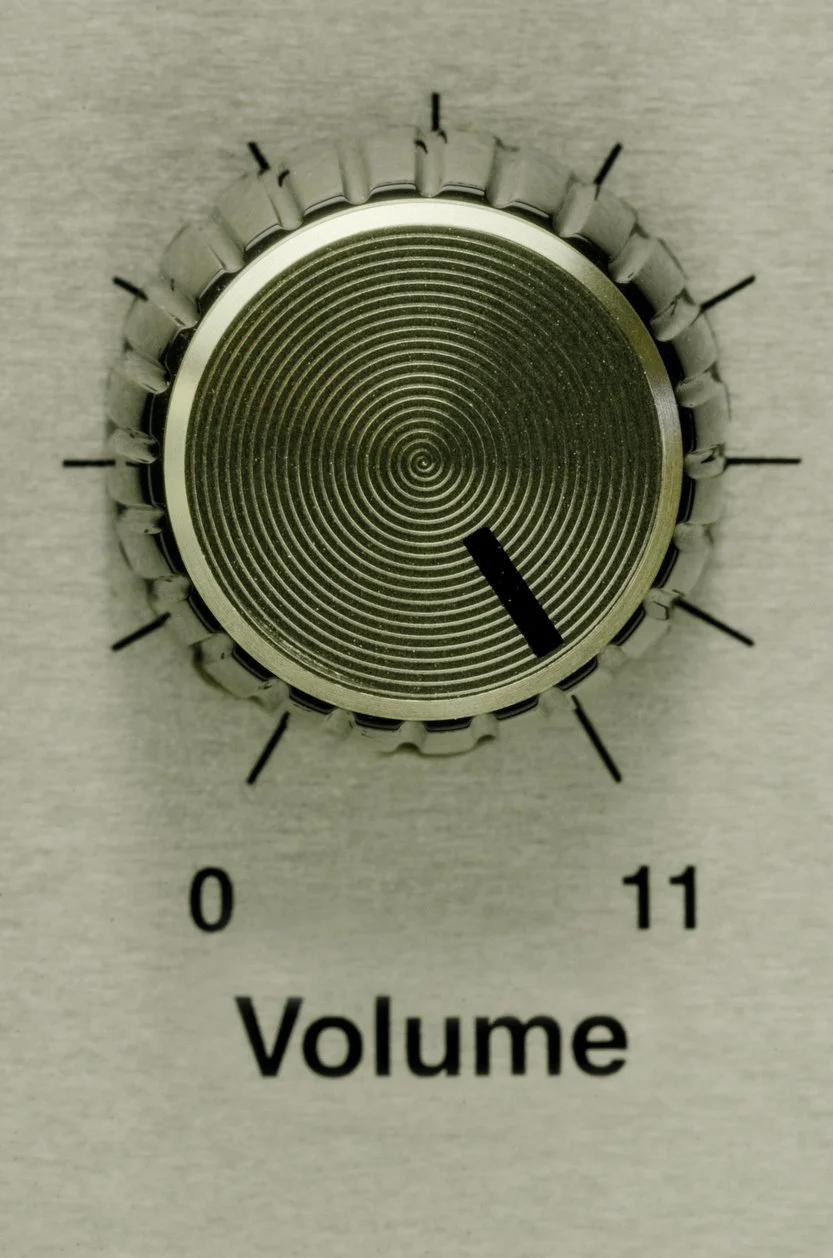
This Dial Goes To 11

Like a stereo’s master volume dial, your nervous system regulates the amount of pain you feel. Massage cues the nervous system and dials down pain.


A scenario plays out every day in the massage studio: a super-stressed client enters the room, desperately in pain, and then leaves an hour later, visibly relaxed, and feeling dramatically better. Maybe it was the targeted massage work I did, but also, another, less tangible factor is at work - the nervous system.


This Dial Goes To 11

Did you know that your nervous system can dial pain signals up or down, like a stereo’s master volume dial? When you are stressed, the dial goes to 11 (hello, Spinal Tap fans, I see you!) Pain signals are prioritized, and played at a loud volume. When you are relaxed, the nervous system adjusts the volume down, and pain signals are universally muted.


In simple terms, the nervous system operates on a continuum on the volume dial between 1 “rest and digest”, and 11 “fight or flight.” 


Rest and Digest

At 1 on the dial, “rest and digest”, your PNS - Parasympathetic Nervous System, is more active. You are calm. The long and wandering 10th cranial nerve, the vagus nerve, which connects to most of our major organs, releases feel good hormones like serotonin and dopamine. The neurotransmitter  acetylcholine slows heart rate and reduces blood pressure, reduces inflammation and promotes healthy digestion and sleep. The factors you need for healing are present here.  


Fight or Flight

At 11 on the dial, “fight or flight”, your ANS - Sympathetic Nervous System, is more active. You are ready to fight a bear. This state is often driven by the 5th cranial nerve, the trigeminal nerve. Adrenaline creates a fast burst of energy and focus, and your body streamlines itself for quick physical action. Your heart pumps faster to prep muscles for rapid movement. You breathe faster to take in more air. Your liver dumps sugar into your blood for quick fuel. Digestion slows, saving maximum energy for action.


Sometimes The Dial Gets Stuck at 11

Humans are designed to vacillate easily between the states of 1 “rest and digest” and 11 “fight or flight” on the dial, and ideally spend more time in 1, “rest and digest”. But there are all sorts of reasons where the volume dial might go to 11 and get stuck there, either for short periods for stressful life events, or longer term - think of people with anxiety, chronic stress, in difficult perimenopause stages, or with certain health conditions that trigger anxiety.  


When we are stuck at 11 “fight or flight”, the PNS and vagus nerve are pushed into the background, and have a harder time coming back online. It creates a state where pain signals are intense, and healing and digestion are slow.


Massage Activates “Rest and Digest”

Have you ever experienced a profound downshift of your energy during a neck massage? The neck at base of the skull is one of many direct areas of stimulation for the vagus nerve. Massage here activates the calm states of the vagus nerve and PNS - Parasympathetic Nervous System. The vagus nerve can be activated either by direct pressure like in a massage, or like in popular gadgets that hack the vagus nerve, through resonance or small electrical pulses. In any of these scenarios, you turn the master volume dial down to 1, and get back to “Rest and Digest”. Pain signals are more muted, less sharp than before. 


Communication is a Two Way Street

Your nervous system is in constant dialog with the rest of your body. So there’s an opportunity to influence the conversation by addressing the physical aspects of your body. Even if the dial is stuck at 11 “fight or flight”, when massage mimics “rest and digest” states elsewhere in the body, it convinces the nervous system that it might be ok to dial down to a more relaxed state. 


Unwinding Muscle Tension

Tight muscles send a message to the nervous system that you are in 11 “fight or flight.” Massage helps release muscle tension, allowing the body to shift to 1 “rest and digest.”


Slower Breathing

Massage encourages longer, diaphragmatic breaths, which is one of the quickest, easiest hacks to activate the vagus nerve, and switch the nervous system into rest and digest. As a matter of fact, this is something you can do right now. Or while driving. I’m a big fan of …4 seconds breathe in, 4 seconds hold, and then 10 seconds breathe out. (If you can’t manage 10 seconds, try 6, or whatever’s a manageable number for you.) Repeat 25 times.


Less Stress Hormones

Studies show that massage reduces stress hormones, like cortisol. It’s yet another signal to your brain that it might be ok to shift to a more relaxed state.


Overall, massage addresses your muscles, and communicates with your nervous system. It’s a great way to dial down aches and pains, and downshift into a more relaxed state.


Schedule A Massage

If your interest is piqued, schedule a massage here.


The Latest on Covid Precautions

My goal is to make everyone feel safe and welcome, no matter their risk tolerance or situation. Here’s what is happening in the massage studio for the foreseeable future.

Your Massage Therapist

I am fully vaccinated. I will be wearing a face mask, a well-fitted N95, for all client work, for the foreseeable future. 

Been Sick in the Past TEN DAYs?

If you've been sick in the past 10 days  (cold, flu, or covid), please contact me BEFORE YOU ARRIVE to let me know when your symptoms started and ended. If you currently have symptoms, such as a fever, please reschedule, free of charge. My own immune system is sluggish, so other’s small colds can mean weeks out of work for me. Email or text 510-604-2005.

Client Face MAsks

Your Choice. Client face masks are no longer required in the massage studio. If you’d like to wear one, you are welcome to. If you don’t want to wear one, that’s also ok.

Healthy Airflow

Access to Outdoor Air, Before and Between Clients. Opening the two windows and the door creates a medium to strong cross breeze in the massage studio, depending upon the weather outside. Before opening the massage studio in the new location, I replaced the standard windows with side opening windows, dramatically increasing potential airflow. Instead of just the bottom third of the window opening, nearly the entire window surface area opens. The window openings are oriented to take advantage of the most frequent wind direction (north west) of the Bay area. (Who knew all that geeky weather knowledge from kayaking would come in handy?)

There’s 30 minutes between clients. The windows and door are open for about 15 of those minutes, and due to that strong cross breeze. most of the air in the massage studio is replaced by outdoor air. (Yes, I do this even on cold days.) Once the workday has started, I do not remove my face mask while inside the massage studio. The idea is that an immunocompromised client could come in after any other client, and be reasonably certain of breathing mostly fresh outdoor air.

Air Filters. There are also air filters in the massage studio, capable of filtering the air in the space 12 times an hour, the same safety standard that new hospital construction must meet. The filters are specifically selected to remove particles as small as viruses, as well as wildfire smoke. The air filters are turned on about 15 minutes prior to the first client of the day, and stay on, until about 15 minutes after the last client has left.

Outdoor Air During Your Session. If you prefer additional outdoor air, you can choose to leave the windows (and even door) open- just ask.  The default is closed windows and door during your session - most people are more concerned with staying warm, and having a quiet environment, but whatever you prefer is fine. The massage studio is located in an urban neighborhood environment - inevitably, there will be some level of noise outside.


Touchless Access

Touchless client access to things like soap, hand sanitizer, and paper towels

Surfaces

Based on the standard best practices for massage studios, I disinfect surfaces once a day. Obviously, any items that may touch a client’s face, like the headrest or pillows, are fully covered by linens. Linens are washed between uses.

Thanks!

-Andrea

Let's Talk Trigger Points

You might have seen a chart of the human body with little dots all over it at some point, maybe in a physical therapy office, or a massage studio. So, what's that all about?

Trigger Point

Back in the 1940's, two medical doctors began researching people with severe "untreatable" pain. Most of the research subjects had spent years in pain, and had exhausted the cures of Western medicine, yet nothing worked. Our researchers found that most of their subjects had one thing in common: trigger points.

A Point of Exquisite Tenderness

A trigger point is technically defined as a "point of exquisite tenderness". In physical terms, it's a circle of hyper-irritable tissue, generally located within a taut band of muscle. Trigger points can cause intense pain, which can be just local at the exact location of the trigger point, or it also can be referred to another location.

Trigger points arise as a result of acute trauma, or repetitive motion that causes trauma over time.

Encouraging Wider Spread Dysfunction

The area directly surrounding the trigger point often feels very tight, with a decreased range of motion. If one area of the body is unable to move as designed, neighboring areas will step in to help accomplish tasks. So, in the case of trigger points, the immobile trigger point will cause surrounding muscles to compensate. The degree to which this causes problems varies, but it creates a higher risk for injury during strenuous events.

It’s Crazy Common

The researchers estimated that 75% of pain clinic patients have a trigger point as the sole source of their pain.

Want an example of a trigger point? Most people have at least one trigger point in their neck or shoulders. Using the above image, locate a typical trigger point area in the neck or shoulder and press down. If that spot feels super tender, even more so than the surrounding area, you may have discovered your first trigger point.

If your sense of touch in your hands is sensitive enough, you'll notice that a trigger point feels like a nodule of muscle fiber that's far harder than the surrounding tissue. Note: A sense of touch takes months to develop in massage students, so don't be discouraged if your fingers don't notice any differences from place to place. However, I've been a massage therapist for 20 years, so they feel like flashing neon signs to me! Which is one of the ways I know that we are working in the right location to make positive changes.

How Trigger Point Massage Works

Trigger point massage addresses these areas by pressing and holding the area to dissolve the trigger point, and free the immobile muscle tissue. When treated in conjunction with the wider area, it can restore the entire region to proper function.

Schedule A Trigger Point Massage

If your interest is piqued by trigger point therapy, schedule a Trigger Point massage, using online booking, here.